Business Model - Base Layer: Subscriptions
Info
Subscriptions in DARCA are the foundation of the business model, not the entire business model by themselves.
Other revenue streams and monetization layers are described in separate sections.

Subscription as the Foundation of the Business Model
Subscriptions provide predictable unit economics and keep the product structurally simple: a module is either included or not, while scaling happens through limits.
Tip
DARCA uses the Subscription model as a “value bundle” and Freemium as a clear entry point.
- We do not monetize user mistakes or build revenue on hidden losses.
- Plan differentiation is not about “speed” or “support quality”.
- Plan differentiation is only about:
- limits on operations and volume
- overage when limits are exceeded
- modules (a module is either enabled or absent)
- for businesses: separate teams and workflows, but the quality of service as a standard is always maintained

Plan Lineup
Four plans for individuals and freelancers, plus a separate Business tier for legal entities.
Note
DARCA does not have “basic” or “advanced” versions of modules. That would complicate navigation. A module is either included in a plan or not included at all.
- Base — free, for onboarding and regular basic usage
- Plus — mainstream paid tier, covering most everyday and work scenarios
- Pro — maximum tier for active users and higher volumes
- Custom — builder plan: modules and limits tailored to a specific need
- Business — subscriptions for companies: workflows, roles, integrations, API, SLA

Limits and Overage Rules
Plan economics are driven by limits and transparent overage, not by “cutting down” the product.
Warning
Transaction speed is not restricted by the plan. If transfers are instant, they are instant across all tiers.
- Each plan includes:
- limits on volume and number of operations
- limits on total turnover within a given period
- Within limits, the plan terms apply.
- Once limits are exceeded, overage is triggered under clear, transparent rules.
- Limits can be risk-based:
- depending on verification level and account history
- increasing with stable behavior and earned trust
- High-risk actions may require additional confirmations, but this is not “tier speed” — it is risk policy.

Base
Base provides the full DARCA experience and introduces the platform logic, with smaller limits and a limited set of modules.
Example
Base should feel like a real product, not a demo: users can integrate DARCA into daily life, and as volumes grow, upgrading becomes a natural next step.
Who it’s for
- individuals who want to unify their finances in one place
- early-stage freelancers testing core everyday scenarios
What’s included
- Core: balances, history, statuses, notifications, in-app support
- Modules (included in Base):
- Messenger
- Savings Vault
- Habit Tracker
- My Games
What’s limited
- limits on external operations and turnover
- once limits are exceeded, overage applies
Support
- support quality is part of the product and remains high across all plans
- Pro and Business have dedicated teams for complex cases and corporate workflows, but this does not reduce the standard level of support for everyone else

Plus
Plus increases limits and adds modules, covering most everyday scenarios without constantly hitting restrictions.
Tip
Plus is not sold as a vague promise of “convenience”, but as something concrete: higher limits and more modules.
Who it’s for
- individuals with regular transfers, exchange and savings habits
- freelancers with steady incoming payments and recurring withdrawals
What changes compared to Base
- significantly higher limits on operations and turnover
- overage triggers less often due to wider limits
- Additional modules included in Plus:
- P2P
- Staking
- Crisis Vault
- Enhanced Security
Note
Enhanced Security is a separate module. It is either included in the plan or added through Custom.

Pro
Pro is designed for high turnover and high cost of mistakes: maximum limits and the full module suite.
Warning
We do not use the wording “unlimited limits.” In Pro, limits are set at the highest level and managed through risk-based rules.
Who it’s for
- active users with large transaction volumes
- freelancers operating at high turnover
- users who want every platform module available in one unified system
What Pro provides
- the highest possible limits with predictable overage rules
- the complete module suite (everything included):
- all modules from Base and Plus
- Cold Storage
- Token Creation
- NFT
- RWA
- Mining
- other modules from the DARCA catalog
Support
- support quality remains consistently high across all plans
- Pro includes a dedicated team for complex cases and accelerated handling of non-standard workflows

Custom
Custom exists so users can pay only for what they actually need: specific modules and specific limits, without upgrading to a higher plan.
Question
Custom solves the problem: “I need one module, but I don’t want to overpay for Pro.”
What can be configured
- choose any modules (on or off)
- select the required limits and turnover level
- define overage rules tailored to the scenario
Pricing principle
- base plan (usually Base or Plus) + cost of selected modules + cost of selected limits
- no “tiers inside a module” and no added navigation complexity

Business
Business is the subscription tier for companies, where value comes from processes, roles, integrations, APIs and operational control.
Danger
Business is not “Pro for business.”
It is a different layer: operational workflows and corporate governance.
Who it is for
- freelancers operating as legal entities and small teams
- small businesses
- mid-sized businesses
How the Business subscription works
- company package + seats
- business modules (e.g. Payments, reporting, roles, approvals)
- integrations (accounting, CRM, HoReCa) and automation
- API and webhooks based on usage:
- SLA and support coverage:
Support
- the high support standard remains consistent across all plans
- Business has a dedicated team because corporate workflows introduce approvals, documentation and compliance processes

Plan Selection Scenarios
Plans are chosen as needs and transaction volumes grow, not because “a feature got locked.”
-
Individuals:
- Base for onboarding and regular everyday scenarios
- Plus when volumes increase and limits are reached more often
- Pro when the full module set and maximum limits are needed
-
Freelancers:
- Base to get started
- Plus for ongoing work
- Custom if only one module is required (e.g. Security) or a specific limit
- Pro for high turnover and the need for all modules
-
Small business:
- Entry-level Business for accepting payments and basic workflows
- Growth through seats, integrations, reporting, and Payments
-
Mid-sized business:
- Advanced Business for treasury, approvals, API, integrations and SLA

Why the Model Scales
Subscriptions create MRR, limits and overage protect unit economics, while Custom and Business increase ARPU without adding product complexity.
Tip
This structure supports stronger Unit_economics: Base lowers the entry barrier, Plus drives mass-market MRR, Pro and Custom grow ARPU, and Business delivers high LTV.
-
Predictability:
- subscriptions generate stable MRR
-
Growth without conflicting incentives:
- revenue grows together with real usage and delivered value
-
Product simplicity:
- a module is either included or not
- the differences between the plans are clear and can be explained in one sentence: limits and module composition

Module Monetization
Modules are enabled through subscriptions and Custom, while additional revenue is generated inside modules via action-based fees, B2B revshare, and services, without breaking the principle of “inside DARCA, no commissions.”
Info
In DARCA, a module is either included or not. Monetizing a module does not mean “charging for access” — it emerges from actions, objects and B2B partnerships.
General Principles
-
Modules are activated:
- through subscription plans (Base, Plus, Pro)
- or via Custom as a configurator
- Business has its own tiering and module bundles for companies
-
Inside DARCA, we aim to keep actions commission-free within plan limits.
-
When external rails and risk costs must be covered, we apply:
- a limit-based model
- transparent overage rules
- separate policies for external actions (e.g., external transfers)

P2P
P2P is monetized through a fee on successfully completed trades, not for listing ads or attempts.
Tip
The fee is charged only upon a successful deal, when the status is “completed” and settlement has been executed.
-
Revenue source:
- transaction fee (percentage or fixed)
-
How it works:
- the fee is deducted only after the deal is completed
- transparent calculation of “what you give” and “what you receive” before confirmation
-
Why this is fair:
- the fee pays for the infrastructure of “P2P without manual transfers” (auto-reserve and auto-settlement)
- it reduces disputes, errors and fraud
-
Additional:
- trades involving RWA inside P2P may carry a separate fee, since they add a layer of documentation and accounting
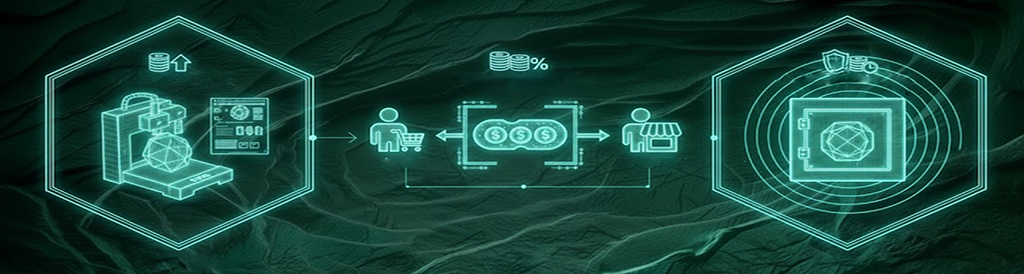
RWA
RWA provides 3 revenue streams: issuance, secondary turnover, and servicing, while the user gets an infrastructure of statuses, documents, and redemption.
1) Issuance fee (origination fee)
- when a new asset object or pool is created
- covers:
- the structure and rules of issuance
- the documentation layer and Object Vault
- payout and redemption parameters
- publishing the object in the marketplace and making it available within the ecosystem
2) Transaction fee (secondary fee)
- applied when trading RWA tokens within the ecosystem and on P2P
- covers:
- accounting, statuses, checks and the compliance layer
- escrow mechanics and reduced risk of user errors
3) Servicing fee (servicing fee)
- a recurring fee for administering the asset object
- includes:
- reports and scheduled payouts
- updates of the object’s statuses and events
- support of redemption under the defined terms
Example
In RWA, the user pays not “for the token”, but for the infrastructure of trust: documents, statuses, transparency and managed events.

NFT
The NFT module is monetized through issuance and B2B verification, while fees apply only when NFTs are transferred out to external Web3.
Info
Internal NFT transfers inside DARCA are not charged. A fee applies only for external transfer — moving NFTs to external networks and wallets.
-
Revenue streams:
- mint fee — a fee for issuing NFTs (if minting happens inside DARCA)
- B2B verification — a fee for collection verification and Verified status (paid by the project, not the user)
- external transfer fee — a fee applied only when withdrawing NFTs to external Web3
-
Why this model:
- inside DARCA, UX stays fee-free within plan limits
- external actions carry infrastructure costs, risk exposure and additional security load

Token Creation
The token creation module is monetized through issuance and listing, not through complex in-product conditions.
Tip
Creating a token is a paid action because it includes issuance infrastructure, product-level visibility, and readiness for circulation inside the ecosystem.
-
Revenue streams:
- a fee for token issuance
- a fee for token listing within the ecosystem (catalog, marketplace visibility, availability for operations inside DARCA)
-
Optional:
- if the token is withdrawn to an external wallet or external networks, external-action rules apply

My Games
The “My Games” module is included in all plans, including Base, and is monetized through B2B partnerships with game companies, not through user fees.
Note
The user does not pay any commission for access to the “My Games” module. Monetization comes through B2B revshare with publishers and official partners.
- Revenue streams:
- revenue share from digital goods sales and donations
- partner agreements for placement and distribution inside the marketplace
- performance-based models for large partners (linked to conversion or volume growth)

Mining
Mining is monetized through action-based fees and partner models, without any yield promises.
Warning
DARCA does not promise mining returns.
We sell convenience, transparency, and infrastructure for managing the process.
- Revenue streams:
- fees for specific actions inside the module (e.g., connection, withdrawals, distribution, auto-conversion)
- partner revshare with mining or hosting providers
- Principle:
- fees apply to concrete services and actions, not simply to “having the module”

Staking
Staking is monetized through a small action fee or a share of yield, while remaining fully transparent for the user.
Tip
Before confirming, the user sees the final “net” outcome and clearly understands what they will receive.
- Revenue streams:
- a small fee for actions (stake, unstake)
- or a small share of yield (depending on the model)
- partner revenue from providers if external infrastructure is used

Enhanced Security - Security Assist
Within the Enhanced Security module, an additional paid service appears: Security Assist, allowing users to request security, police, or legal support through partners.
Danger
Security Assist depends on the country and partner infrastructure.
DARCA enables the process, incident logging, and a protected emergency flow, but does not promise unrealistic response times from external services.
-
How it works:
- an emergency request button inside the app
- incident logging and an automatic incident package
- notification of trusted contacts and emergency account lock option
- connection to a partner (security, police, lawyer) depending on regional availability
-
Monetization:
- pay-per-incident or per-case fee
- Pro and Business may have corporate terms via separate agreements

Overage - fees for exceeding limits
Fees in DARCA do not work as a “tax on every action”, but as a predictable charge only when plan limits are exceeded. This keeps the model fair for users and sustainable for the business.
Info
Within plan limits, operations run with no fees or only minimal external costs.
The fee activates only when limits are exceeded and applies only to the excess portion, not the full volume.
How it works
-
Each subscription plan defines:
- limits on key actions
- how limits are measured (by period and operation type)
- overage rules when limits are exceeded
-
While the user stays within limits:
- transactions remain instant
- the product stays simple and predictable
-
When a limit is exceeded:
- a fee applies to the excess
- the user sees the final outcome before confirming
Tip
Overage always applies only to the excess, not the full transaction amount.
This reduces frustration and makes the model fair.
Why this is part of the business model
- Subscriptions provide stable baseline revenue (MRR).
- Overage adds revenue that scales with activity and turnover.
- Even without upgrading, increased usage generates additional revenue.
- The user always has a clear choice:
- upgrade the plan to reduce the chance of overage fees
- stay on the current plan and pay only when limits are actually exceeded
Note
This model removes the conflict of interest of “the bank earns on every transaction”.
DARCA earns from real growth in value and turnover, with transparent rules.
Higher plans make overage more favorable
-
Base:
- small limits
- higher overage fees, as the plan is meant for onboarding and basic use
-
Plus:
- significantly higher limits
- lower overage fees than Base
-
Pro:
- maximum limits
- minimal overage fees, and exceeding limits is rare
-
Custom:
- the user chooses the balance:
- raise limits to trigger overage less often
- or keep limits lower and pay only when excess happens
- Custom optimizes cost for a specific scenario
- the user chooses the balance:
Limit types that can trigger overage
-
Total turnover limit per period:
- total volume of operations per week or month
-
Transaction count limit:
- number of external transfers, exchanges, withdrawals per period
-
Category-specific limits:
- external actions with infrastructure cost or higher risk
- e.g. external transfer for NFT
-
Module-specific limits:
- in modules where load and risk grow with frequency of use
Warning
Transaction speed is never limited by the plan.
Overage affects only pricing when limits are exceeded, not the execution speed.
Transparency and control
-
Before confirming an operation, the user can see:
- what exactly counts toward the limit
- what portion will be treated as excess
- what fee will be applied
-
The product includes:
- notifications when approaching limits
- warnings before overage activates
- a clear history of overage charges
How overage works together with module monetization
- Overage is a universal rule that sits on top of the entire platform.
- Modules can have their own revenue streams, but overage does not conflict with them:
- P2P - deal-based fees plus a limit model by turnover and trade frequency
- NFT - transfers inside DARCA are fee-free within limits, fees may apply on external transfer
- Staking and mining - small action-based fees, while limits and overage apply to external withdrawals and conversions
- RWA - fees for issuance, secondary trades, and servicing, plus turnover and activity limits where required by risk policy
Example
Overage makes the model flexible: the subscription provides freedom within limits, and increased activity starts generating revenue without degrading the core UX.

Final logic: how DARCA earns and why it scales
The model stands on three revenue layers: subscriptions as the base, overage as activity-driven scaling, and module monetization as additional diversification without making the product complex.
Info
Subscriptions provide predictability, overage turns volume growth into revenue, and modules add income through actions or B2B partnerships, while keeping the principle “inside DARCA, no fees” within plan limits.
1) Subscriptions — the base layer (MRR)
- Subscriptions create stable cashflow and a clear growth ladder:
- Base lowers the entry barrier and delivers a real product, not a demo
- Plus becomes the mass-market plan for regular daily use
- Pro covers high-volume users with a high cost of error
- Custom prevents churn by letting users buy the exact modules and limits they need without overpaying
- Plan differences are simple and explained by one logic:
- limits
- overage
- modules (a module is either included or not)
2) Overage — the scaling layer driven by activity
- Within plan limits:
- operations remain fee-free or carry only minimal external costs
- transaction speed is never “throttled” by the tariff
- When limits are exceeded:
- fees apply only to the excess portion, not the full amount
- higher plans get more favorable overage conditions
- the user always has a choice: upgrade the plan or pay only when the excess actually happens
- This converts usage growth into revenue growth without degrading the core UX.
Tip
Overage makes the model resilient: activity and turnover automatically generate additional revenue even if the user never upgrades.
3) Module monetization — diversification without tariff complexity
- Modules are enabled through plans and Custom, while revenue appears inside modules where there is external cost, risk, or a partner layer:
- P2P — fees on successful completed trades
- RWA — fees for issuance, secondary trades, and servicing
- NFT — mint fees and B2B verification, with transfer fees only on external transfer
- Token creation — fees for issuance and ecosystem listing
- My Games — B2B revshare with gaming companies, available already in Base
- Mining and staking — small action-based fees and partner models
- Enhanced Security — Security Assist as a paid incident-based service, not affecting subscription logic
Note
Module monetization does not turn the product into a “tariff zoo”: a module is either present or absent, and revenue comes from real usage or B2B.
Why this attracts users
- No hidden monetization on every action:
- within limits there is no “activity tax”
- overage rules are clear upfront
- No artificial restrictions on “speed” or “support quality”:
- instant transactions remain the standard
- high-quality support stays part of the product for everyone
- The product remains simple:
- no “basic vs advanced” module tiers
- upgrades happen for one reason: higher limits and needed modules
Why this enables growth and profitability
- Subscriptions provide the foundation, overage scales with turnover, modules add revenue from actions and partnerships.
- The model is diversified: income does not depend on a single stream.
- Risk and cost are controlled through limits, risk-based rules, and transparent statuses, reducing losses and disputes.
- Economics strengthen as the platform grows:
- more active users increase MRR
- higher turnover increases overage revenue
- deeper module adoption increases action-based and B2B income
Example
The result is a model where users get simple rules and a predictable experience, while the business grows revenue alongside activity growth — without breaking the core UX or making the product harder to understand.